Kazakh Altai
Forested mountains in the northeast, bordering Russia, China and Mongolia, home to Kazakh eagle-hunting herders and ancient Russian Old Believer communities.
The Kazakh Altai occupies the far northeast of the country, in the region of eastern Kazakhstan, where the borders of Kazakhstan, Russia, China and Mongolia converge. Our English-speaking team at the capital organizes itineraries from Öskemen (Ust-Kamenogorsk), the logistical gateway located approximately 2 hours' flight from Astana or Almaty. From there, allow another 6 to 10 hours by road to reach the most remote valleys, around Katon-Karagai, Berel or Lake Markakol.
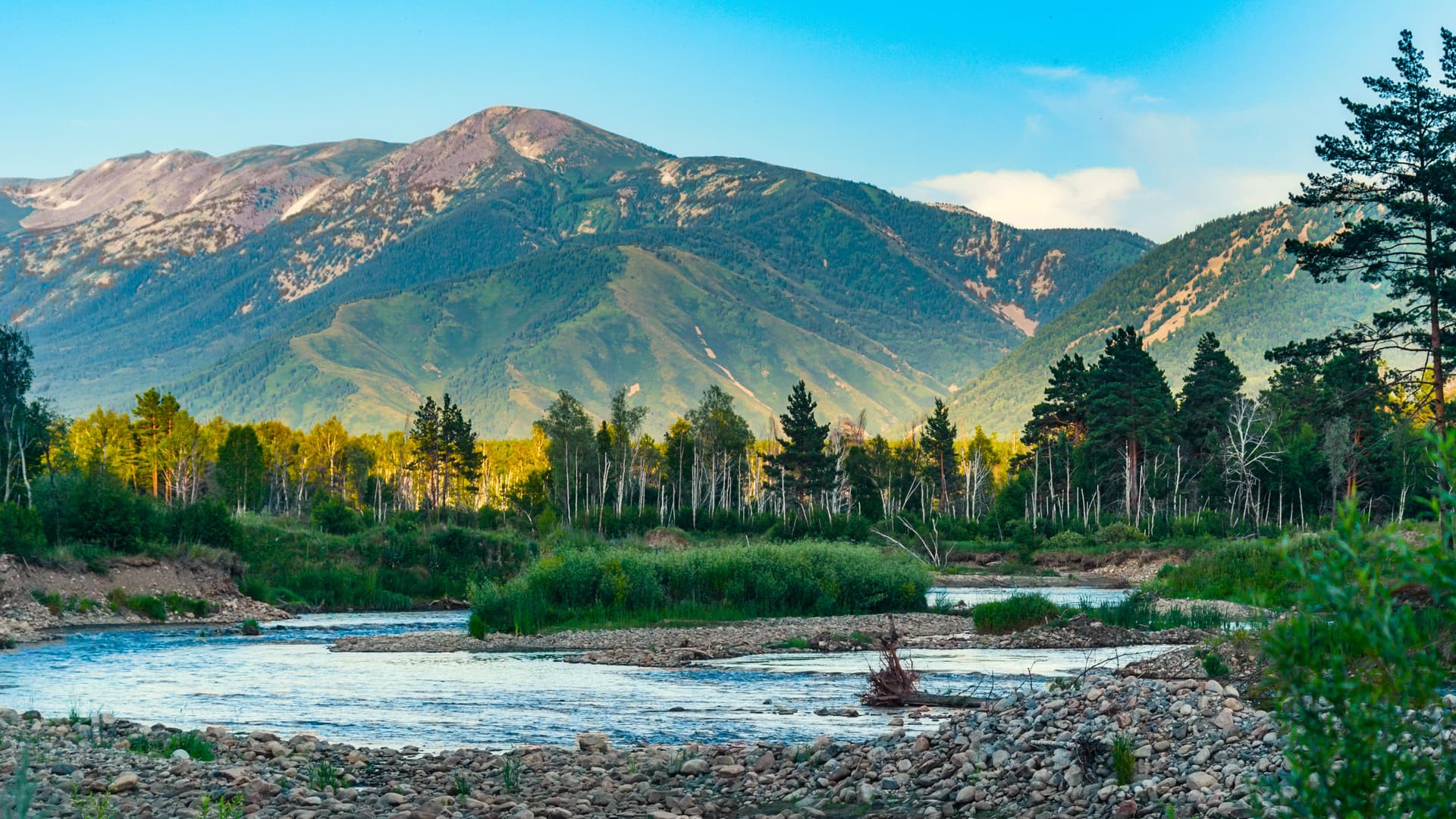
The geography contrasts sharply with the classic image of steppe Kazakhstan. Here, the terrain rises to Mount Belukha (4,506 m, on the Russian side) and the massif is covered with larch forests, Siberian cedar and birch. Glacial valleys cut into altitude plateaus where herds graze in summer pasture from June to September. The Irtysh, one of Central Asia's great rivers, originates in these mountains before flowing across the entire country northward. Lake Markakol, at 1,485 meters altitude, is designated a nature reserve and harbors an endemic trout variant, the uskutch.
Katon-Karagai National Park, created in 2001 and inscribed as a UNESCO Biosphere Reserve, covers more than 600,000 hectares. Within this perimeter we take our travelers on hikes on the foothills of Belukha, to visit the Scythian kurgans at Berel (princely tombs from the 8th-3rd centuries BC excavated since the 1990s), or to reach the hot springs at Arasan-Berel. Rakhmanov Valley, with its lake and hot baths at 40°C, often serves as a base for 2 or 3 nights.
The Kazakh Altai is also a living Kazakh-Mongol territory. Families settled in the valleys of Berel or Maraly practice the herding of horses, yaks and sheep, and some maintain berkutchi, the hunting of golden eagles, passed down from father to son. Unlike the neighboring, more publicized Bayan-Ölgii in Mongolia, the practice here remains discreet and family-based. We work with two families of eagle hunters who host a limited number of travelers per season, in their winter houses or under yurts (kiiz üï) in summer.
Cuisine reflects the herding tradition: beshbarmak (wide noodles and boiled lamb served on a communal platter), kazy (horse sausage), kumis (fermented mare's milk) in July-August when mares are nursing. In the Russian Old Believer villages of Berel or Ouryl, settled in the 18th century to escape Peter the Great's religious reforms, you also taste pelmeni and cedar berry preserves. This Kazakh-Russian-Altai mix gives the region its unique cultural character, without equivalent elsewhere in Kazakhstan.
The Kazakh Altai is not a destination for the impatient traveler. The useful season lasts four months, secondary roads are unpaved, accommodations are simple (family yurt, rural guesthouse, two or three modest hotels in Katon-Karagai). But for those seeking inhabited mountains, forested landscapes no one associates with Kazakhstan, and direct contact with nomadic families who do not live off tourism, it is the most accomplished region of the country.
Highlights
Lake Markakol and nature reserve. High-altitude lake, 38 km long, surrounded by larch forests and edelweiss meadows. Possible observation of brown bears, elk and golden eagles from the villages of Urunkhaika or Kaiyrly.
Scythian kurgans at Berel. Archaeological site of frozen princely tombs of the Saka people, excavated by Zainolla Samachev's team. The local museum displays reconstructions of the gold harnesses and sacrificial horses found in the permafrost.
Eagle hunting with a Kazakh family. Meeting with a berkutchi from the Berel or Sarymsakty valley, demonstration of falconry and overnight in a yurt. Authentic practice in September-October when eagles are trained before winter.
Rakhmanov Valley and hot springs. Glacial lake at 1,760 m altitude, accessible after 4 hours by track from Berel. Radon-bearing thermal baths in wood structures used since 1763, starting point for hikes toward the glaciers of Belukha.
Russian Old Believer villages. At Ouryl, Korobikha or Berel, starovery communities settled since the 18th century preserve wooden isbas, embroidered costumes and ancient liturgical chants. Homestays possible.
When to go
The useful window is short: mid-June to mid-September. Before June 15, high altitude passes (Bourkhat at 2,100 m, Austrian Road) can remain snow-covered and tracks to Markakol or Rakhmanov are impassable. July and August are the most stable months, with daytime temperatures of 18 to 25°C in valleys, 8 to 15°C at altitude, and nights around 5 to 10°C. Afternoon thunderstorms are frequent in July. September offers autumn colors on the larches (brilliant yellows from September 10-15 onward) and is the best period to observe eagle hunters in action, but nights drop below 0°C from mid-September in the highlands.
From October to May, the region experiences a long winter: temperatures of -20 to -35°C in January-February, persistent snow, access to interior valleys closed. A few winter stays focused on eagle hunting and sledding are possible around Katon-Karagai in February-March, but with heavy logistics and spartan comfort.
Practical advice
We recommend a minimum of 7 days on site, ideally 9 to 10, to absorb the distances and enjoy each stage without driving every day. The classic itinerary: flight from Astana or Almaty to Öskemen, drive to Katon-Karagai (8 hours), three nights in the Berel-Rakhmanov zone, two nights at Lake Markakol, return via Öskemen. 4x4 vehicles are essential beyond Katon-Karagai, and we systematically provide a driver familiar with the tracks.
The region logically combines with Astana and the central steppes (direct flight, coherence with the north of the country) rather than with Almaty and the Tian Shan, which already offer a mountain environment. For a first trip to Kazakhstan, the Altai suits travelers who accept homestays or yurt accommodation, who hike for a few hours a day, and who are interested in living nomadic cultures more than hotel comfort. Families with children from 10-12 years old, independent trekkers, photographers and contemplative travelers find their footing there. Standard hotel expectations are not the terrain of the Altai: it is a region that must be earned, and earns its merit through the authenticity of encounters.