South and Silk Road
The crescent of Kazakh caravan cities, from Turkestan to Taraz, where the Yasawi mausoleum meets the bazaars of Chimkent and the wild tulips of Aksu-Jabagly.
Southern Kazakhstan forms a crescent stretching from Kyzylorda on the Syr Darya to the foothills of the western Tian Shan near Taraz. This is where caravans once traveled connecting Samarkand to the steppe, and the density of historical sites reflects this: Turkestan, Sauran, Otrar, Sayram, Taraz. Our English-speaking team based in the capital views this region as the country's historical gateway, where Kazakhstan ceases to be merely steppe and mountain and becomes instead oasis city and religious crossroads.
Turkestan, ancient Yasi, is home to the mausoleum of Khoja Ahmed Yasawi, commissioned by Tamerlane around 1389. The building, UNESCO-listed in 2003, was never completed: wooden scaffolding remains in place on the main façade, and its 38-meter blue dome remains the largest Timurid structure preserved outside Uzbekistan. Around it, the Hazret Sultan complex, inaugurated in 2017, has transformed the city into a regional pilgrimage center, visited by Kazakhs from the south, bordering Uzbeks and Karakalpaks. Forty kilometers southeast, the ruins of Otrar mark the spot where, in 1219, the massacre of a merchant caravan triggered the Mongol invasion of Central Asia.
Chimkent (Shymkent), the country's third-largest city with over one million inhabitants, serves as a logistics hub. Its Upper Bazaar, open throughout the week, sells Sayram melons in September, dried apricots from the Arys valley, salty kourt and spices brought from Fergana. The cuisine here is closer to Uzbekistan than to Almaty: dev-zira rice plov, tandoori-baked samsa, pumpkin manty in winter. Sayram, the eastern outskirts of Chimkent, is an Uzbek village over 3,000 years old that claims to be Ahmed Yasawi's birthplace.
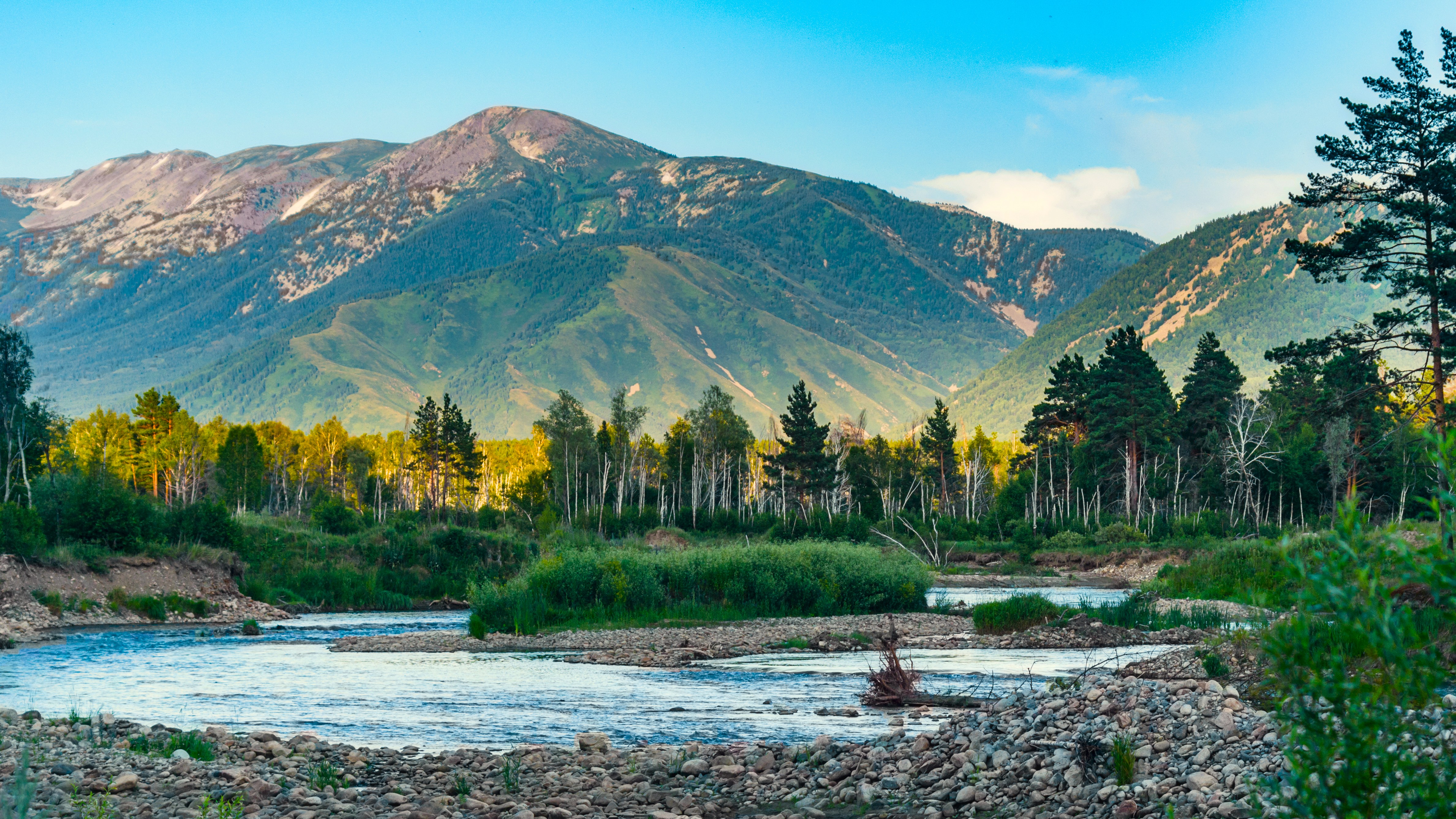
To the east, the Aksu-Jabagly valley is Central Asia's oldest nature reserve, established in 1926 across 1,319 km² on the edges of the western Tian Shan. Altitudes range from 1,100 to 4,238 meters at Sayram Peak. In April, the lower slopes are blanketed with wild Tulipa greigii tulips, ancestors of cultivated tulips, alongside Tulipa kaufmanniana. The reserve is home to the Tian Shan brown bear, Siberian ibex, wolves, and an estimated population of 15 snow leopards on ridges above 3,000 meters. Aksu Canyon, 500 meters deep, is reached in a day's hike from the village of Jabagly.
Further east still, Taraz is one of the country's oldest cities, mentioned by Chinese chroniclers as early as the 6th century under the name Talas. The Battle of Talas in 751, between Abbasid Arabs and the Tang army, took place nearby and marked the lasting arrival of Islam in Central Asia. The Karakhanid mausolea of Aïsha Bibi and Babadji Khatoun, 18 kilometers west of the city, are 11th-12th-century buildings in carved brick, among Kazakhstan's oldest preserved Islamic monuments.
The climate is arid continental: annual precipitation of 200 to 400 mm in the plains, up to 1,000 mm at altitude in the Tian Shan. This is a region where one travels extensively by car, where distances between historical sites are measured in hundreds of kilometers, and where travel fully reveals its meaning if one is willing to encounter sedentary and oasis culture rather than the usual nomadic imagery.
What to discover
Khoja Ahmed Yasawi Mausoleum. In Turkestan, the unfinished Timurid structure from 1389, UNESCO-listed, with its 38-meter blue dome and original scaffolding still in place on the façade.
Wild tulips of Aksu-Jabagly. From the first week of April through mid-May, the slopes of Central Asia's oldest reserve are carpeted with red Tulipa greigii, ancestors of all cultivated tulips.
Chimkent Upper Bazaar. Sayram melons, salty kourt, tandoori samsa and Uzbek plov in a city where cuisine departs distinctly from northern Kazakh norms.
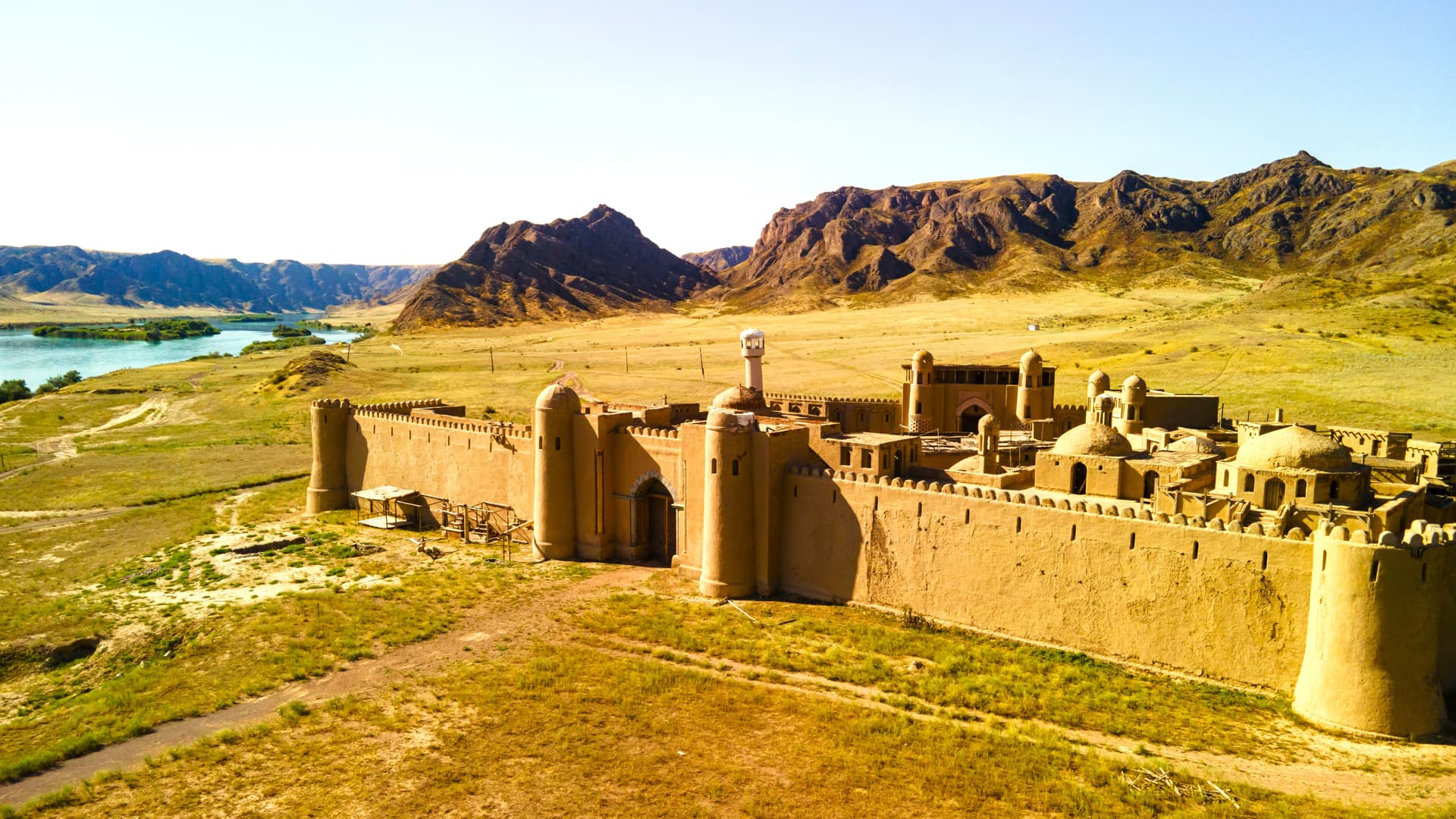
Ruins of Otrar and Sauran site. Caravan city whose 1219 siege triggered the Mongol invasion, and Sauran fortifications with earthen ramparts still legible in the steppe.
Karakhanid mausolea of Aïsha Bibi. Eighteen kilometers from Taraz, two 11th-12th-century mausolea in carved brick, among Kazakhstan's oldest preserved Islamic monuments.
When to visit
The most comfortable window covers April, May, early June, then September and the first half of October. In April-May, temperatures in Chimkent range between 12 and 25°C, tulips bloom at Aksu-Jabagly and orchards in the Arys valley are in full bloom. September brings melons and grapes, with days still reaching 25-28°C and cool nights.
From late June through late August, temperatures in Turkestan and Chimkent regularly exceed 38 to 42°C, making visits to exposed archaeological sites (Otrar, Sauran) challenging before 7am or after 6pm. In winter, December through February, nighttime temperatures drop to -5 or -10°C, with dry winds and little snow in the plains; western Tian Shan passes are closed and hiking at Aksu-Jabagly is no longer possible. High mountain areas remain accessible by snowshoe only with local guidance.
Practical advice
Allow a minimum of 4 to 5 days for this region, ideally 7 if you include Aksu-Jabagly and Taraz. Arrival is via Chimkent's international airport, with daily service from Astana and Almaty, or by overnight train from Almaty (approximately 12 hours). Internal distances are considerable: Chimkent-Turkestan 165 km, Chimkent-Taraz 200 km, Chimkent-Aksu-Jabagly 120 km, almost always on decent roads but slow due to truck traffic.
The most coherent combination pairs the South with Almaty and Tian Shan via a land circuit through Taraz, or an air loop including Mangystau for those wanting to alternate Islamic archaeology with Caspian desert landscapes. Comfort is satisfactory in Chimkent and Turkestan (3 and 4-star hotels, recent guesthouses), more rustic in the Aksu-Jabagly valley where accommodation is with local families in Jabagly. The region suits travelers interested in Silk Road history, Timurid and Karakhanid architecture, and Central Asian cuisine; hikers will also find their footing in the western Tian Shan, less crowded than the Almaty region.