Museum of Musical Instruments
Museum of Musical Instruments
In the heart of Panfilov Park in Almaty, the Ykylas Museum brings together over 1,000 traditional instruments in a 1908 wooden building.
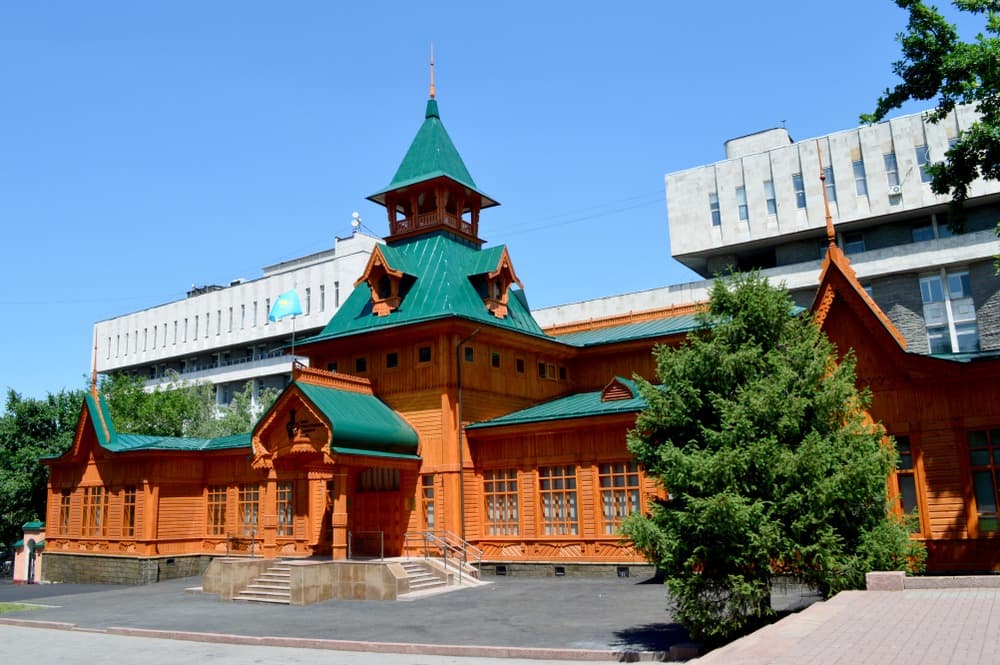
The Museum of Musical Instruments in Almaty, also known as the Ykylas Museum, houses one of Central Asia's most extensive collections of traditional instruments. Housed in a 1908 wooden building, it gathers more than 1,000 instruments representing 60 Kazakh national types, with approximately 400 pieces on display spread across nine thematic rooms.
Why visit this museum
The museum's uniqueness lies in its dual dimension. On one hand, the building itself: one of the few preserved wooden structures from the former city of Verny, a testament to Russian pre-Petrine architecture at the turn of the twentieth century. On the other, a reference scientific collection for understanding Kazakh musical culture, from archaeological flutes to the dombras of great national composers.
Created on August 1, 1980 at the initiative of Uzbekali Zhanibekov, a historian and ethnographer committed to preserving national heritage, the museum opened to the public on April 24, 1981. Since 1990, it has borne the name of Ykylas Dukenuly (1843-1916), a Kazakh folk composer, kobyz player and founder of the kobyz school.
The atmosphere of the place
The building evokes the world of Russian fairy tales, with its double-sloped roofs, its dome-shaped eave reminiscent of medieval churches and its tall three-panel windows framed by wooden sculptures. The composition is triaxial, underscored on the exterior by risalits: the central risalit is topped by a two-level roof pierced by sculptured pediment windows, the side risalits are crowned by sloped metal roofs, and the main entrance opens onto a raised porch in the shape of a keel supported by sculptured pillars.
During the 1979 reconstruction, traditional Kazakh decorative motifs were integrated into the sculptures: agash (tree of life), shynzhara (moving waves), uzilmes (spiraled stem) and otkizbe (horn-shaped loop). The building, constructed in 1908 at the time of the city of Verny, went through several lives before becoming a museum: military administration of the Turkestan governorate, Officers' House in the Soviet era, party club, then Red Star cinema. The renovation conducted between 2012 and 2013 as part of the Year of Culture completely reimagined the museography; the museum reopened to the public on May 15, 2013.
Collections and visit pathway
A collection structured in nine rooms
The pathway unfolds around major themes:
- Origins of folk music and archaeology: ancient flutes, petroglyphs, musical balbals and the shaman altar dated to the 4th century BCE.
- Room of wind and percussion instruments (dauylpaz, dudyga, asatayak, shyndauyl).
- Masters' room, grouping instruments awarded at the republican Anyz dombyra competition.
- Kobyz room, dedicated to the variants of this ancient instrument often crafted from juniper or birch.
- Room of Turkic peoples: 27 instruments from 14 countries.
- Rooms of instruments from around the world, with pieces from Africa, Europe, Southeast Asia and the former USSR.
The oldest pieces date from the 17th century. Among the emblems of Kazakh culture are the dombra, kobyz, sybyzgy, shankobyz, zhetygen, adyrna, syldyrmak and togyldak.
Instruments of historical figures
The museum preserves the personal instruments of Abai Qunanbaiuly, Birzhan Sal, Qurmangazy Sagyrbaiuly, Makhambet Otemisuly and Zhambyl Zhabayev. Notable items include: Abai's three-string dombra, Zharas Baksy's narkobyz linked to a shamanic legend, the saz syrnai discovered at the Otrar site, Shashubai Koshkarbayev's accordion and Bakyz-zhyrau Isabek's kylkobyz.
Interactive features and cultural life
The pathway is enriched by multimedia tables, information kiosks, holographic guides and a sound library. Each room diffuses music adapted to its theme. Visitors can try certain instruments under supervision and conduct a virtual orchestra in an interactive room. A concert hall with 120 seats regularly hosts the Sazgen sazi ethnographic ensemble, as well as lectures, workshops and master classes. A shop and a luthier's workshop complete the visit.
Location and access
The museum is located at 24a Zenkov Street, on the edge of the 28 Panfilov Guards Park, in the Medeu district in Almaty. The nearest metro station, Zhibek Zholy, is approximately a 15-minute walk away. Several bus and trolleybus lines also serve the park's surroundings; as routes change regularly, it is best to check the local network at the time of your visit.
When to visit
The museum is open year-round. Spring and summer remain the most pleasant periods to combine a visit with a stroll through Panfilov Park, when Almaty's climate is milder. Opening hours may change: it is advisable to verify them with the museum before visiting, and to plan a slot mid-morning to enjoy the sound pathway in peace and quiet.
Nearby
The museum is part of a dense heritage complex: the wooden Ascension Cathedral, the 28 Panfilov Guards Memorial and the tree-lined paths of the park can be visited in one go. The Green Bazaar and the shopping streets of the historic centre are just a few minutes' walk away.
Prepare your visit to Kazakhstan
To integrate this cultural stop into a broader itinerary combining cities, steppes and Tian Shan mountains, consult our trips to Kazakhstan.
Fancy staying here?
We can book this accommodation for you.