Aktau Mountains
Aktau Mountains
Southeast of Altyn-Emel park, the Aktau Mountains rise with multicolored ridges, Cenozoic fossils and steppe fauna, 5-7 hours' drive from Almaty.
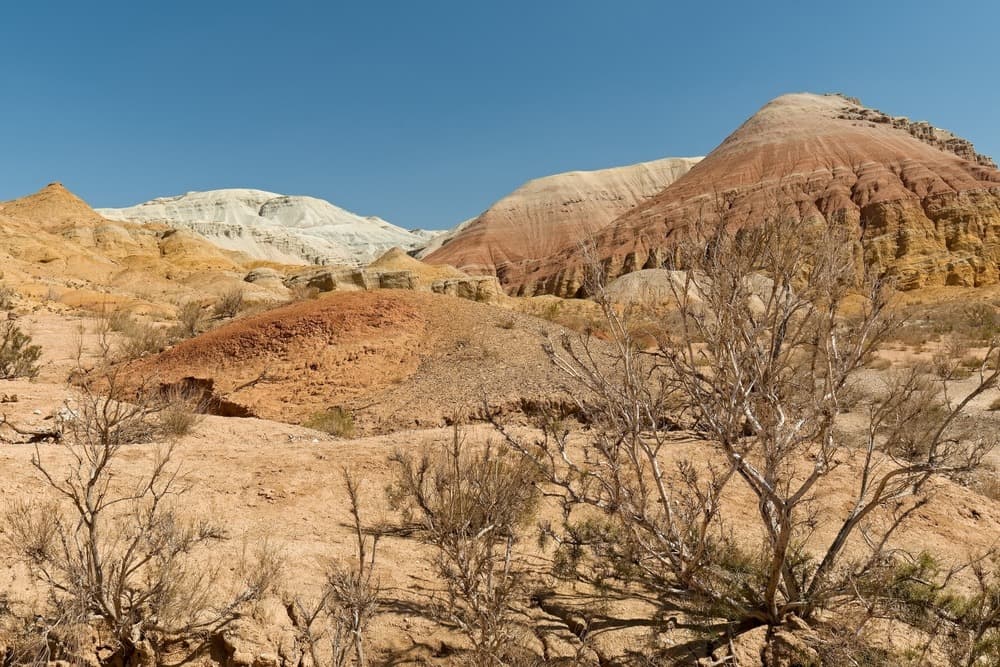
Southeast of Altyn-Emel National Park, in the Almaty region, the Aktau Mountains rise with their multicolored ridges above a desert landscape. Their name means "White Mountains" in Kazakh, yet their slopes blend white, green, red, blue and ochre in reality. This massif, stretching some 30 km in length, ranks as the second major attraction within Altyn-Emel park after the singing dune.
Why visit the Aktau Mountains
The Aktau Mountains combine geological, paleontological and scenic interest. They offer rare terrain where erosion has exposed sediments tens of millions of years old, sculpting conical ridges, canyons and striped cliffs. The site stands as one of Central Asia's great Cenozoic fossil deposits, and hosts remarkable steppe fauna: dzheiran gazelles, kulans, Przewalski's horses reintroduced to the park.
For visitors, it is a wild and little-visited site, accessible only by 4x4 with permit, which limits tourist pressure and preserves the place's quiet character.
Geological history and fossils
The Aktau bedrock formed some 400 million years ago, when the region lay beneath the Tethys Ocean. Marine sediments accumulated in layers of limestone, sandstone and clay. The deposits visible at the surface today date from 60 to 70 million years ago—the end of the Cretaceous and beginning of the Cenozoic. After the sea receded, tectonic movements lifted these layers, then wind and water sculptured them over millions of years.
Paleontologists know the site for its Miocene fossils: remains of prehistoric rhinoceroses, crocodiles, turtles and imprints of ancient subtropical plants. Among notable discoveries stands the Aktautitan, a large brontothere (prehistoric mammal related to rhinoceroses) described from fossils found here. Part of the collections is displayed at the Gylym Ordasy Museum in Almaty, which richly complements a park visit.
What to see on site
The massif spans roughly 30 km east to west and up to 2 km north to south, covering some 50 km². The main points of interest:
- The Red Gorge, with its mountain nicknamed "the paw," one of the massif's most photogenic sectors.
- Pyramid-shaped ridges, with ochre base, red middle and white-blue summit, typical of the local stratigraphy.
- Gypsum and calcite crystals visible on the ground, along with nodules of carnelian, jasper and quartz scattered through limestone and sandstone rocks.
- An isolated willow, reputed several times over a century old (around 700 years according to local sources), growing near a spring in this arid setting.
- Turanga forests (Central Asian poplars) and saxaul bordering the massif, accompanied by Calligonum, Cistanche and haloxylon.
For wildlife, the park shelters dzheiran gazelles, kulans, Przewalski's horses, agamas and jerboas. Raptors abound: golden eagles, lammergeiers, secretarybirds, saker falcons. The park's wetlands, further north, draw herons, ducks and sandpipers.
When to visit
The best periods are spring (April to June) and late summer and autumn (August to October). Daytime temperatures remain between 23 and 25 °C, with cool nights of 5 to 15 °C. Summer is harsh, with daytime peaks near 40 °C and little shade in the massif. Winter is cold, windy, and access to tracks can be difficult.
Low morning and late afternoon light best showcases the rock colors.
How to get there from Almaty
The Aktau Mountains are reached only via the village of Basshi, where the park office and a small museum stand. Here the entry permit, essential for access, is issued. No regular bus service reaches the site: visits occur by private vehicle, typically a 4x4, or through organized excursions from Almaty.
Two main routes connect Almaty to Basshi:
- Route A353 via Konaev (formerly Kapshagai): approximately 292 km.
- Route A351 "Kuldzha" via Shelek: approximately 380 km.
From Basshi, roughly 140 km of desert tracks remain to reach the mountains, heading southeast toward the Ili River. In total, allow 5 to 7 hours travel time between Almaty and the massif. An early morning departure is recommended, and many travelers choose to sleep one night in Basshi or in a park yurt.
Practical information
- Permit: mandatory, obtained from the park office in Basshi.
- Management: protected area run by the state enterprise Altyn-Emel.
- Vehicle: 4x4 essential for the final section.
- Guide: highly recommended, the site has no marked trails.
- Equipment: ample water, sun protection, closed-toe shoes, windbreaker.
- Visit duration: plan a half-day to full day on site, excluding travel time.
Combine with nearby sites
Several destinations in the Almaty region suit a wider circuit around the Aktau:
- The Charyn Canyon, another remarkable erosion formation, more accessible from Almaty.
- The Kapchagay Reservoir, on the route between Almaty and Altyn-Emel park.
- Alakol Lake, further east, to extend discovery of southeastern Kazakhstan's landscapes.
- In Almaty itself, the Central National Museum enriches the historical dimension of your journey.
FAQ
Frequently asked questions
Plan your trip
The Aktau Mountains fit naturally into a wider itinerary around Almaty and southeastern Kazakhstan. To build your stay, explore our Kazakhstan travel ideas.
Interested in this visit?
We can include it in your personalised itinerary.