National Central Museum of the Republic of Kazakhstan
National Central Museum of the Republic of Kazakhstan
Kazakhstan's largest museum, in Almaty: 300,000 objects spread across seven rooms, including the Golden Man Saka and nomadic gold treasures.
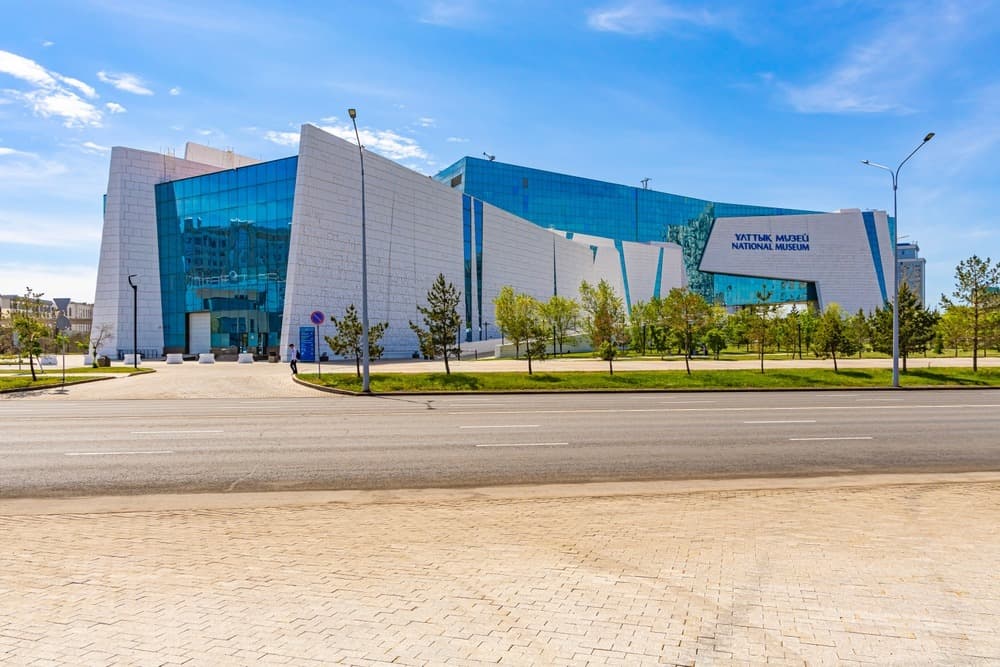
Located in the Samal-1 microdistrict of Almaty, the National Central Museum of the Republic of Kazakhstan houses nearly 300,000 objects spread across seven thematic rooms. Its collections cover paleontology, archaeology of nomadic kurgans, Kazakh ethnography, and the country's modern history. With more than 17,000 m² of building space and 7,000 m² of exhibitions, it is one of Central Asia's largest museums.
Why visit this museum in Almaty
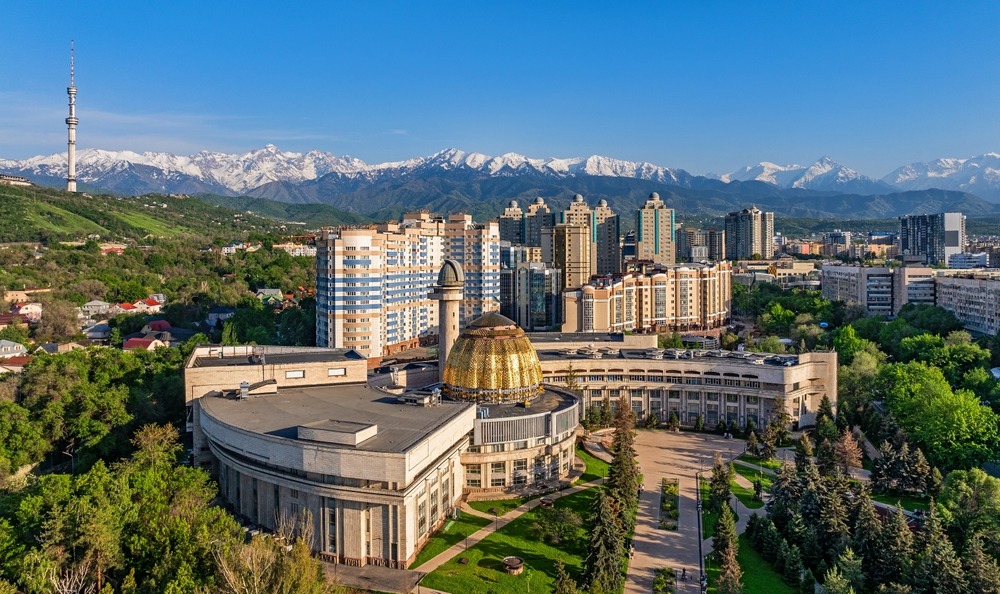
The museum concentrates in one place the essence of Kazakhstan's material history, from regional fossils to Saka gold treasures, passing through nomadic culture and the contemporary pages of independence. For a traveler beginning their journey through the country, it is a useful reference point before exploring archaeological sites, the steppes, or Silk Road cities. The building itself deserves attention: its dome recalls a yurt, and its interior decoration blends marble, parquet, and shell rock.
The museum welcomes over 130,000 visitors each year, organizes around thirty exhibitions and a hundred lectures, and houses Kazakhstan's largest restoration center.
History of the institution
The museum's origins date back to the 1830s, with the creation of the Orenburg Region Museum at the Neplyuev military school, in which linguist Vladimir Dal participated. In 1920, the Kazakh government founded the Central Regional Kazakh Museum in Orenburg, whose collections were transferred to Almaty in 1929.
The institution then settled in the former building of the Ascension Cathedral (1904-1907), designed by A. P. Zenkov and one of the few buildings to survive the 1911 Almaty earthquake. The official opening in the cathedral took place in 1931, and the museum received its current name and status in 1944.
The modern building was constructed between 1978 and 1985 by architects Yu. Ratushny, Z. Mustafina, and B. Rzagaliyev. Its rectangular three-story structure rests on a natural stylobate, supported by external pylons and topped with a large dome. The collections were enriched over the decades through contributions from figures such as Akhmet Baïtoursynov, Akai Nysanbaev, Gabit Moussrepov, Kurmangali Badyrov, or Alkey Margulan, and through numerous ethnographic expeditions. The museum obtained research organization status in 2005, launched its scientific library in 2008 under the leadership of Nursan Alimbay, and has participated in the "Museum Night" since 2006. With UNESCO support, it also developed the "Museologist" electronic cataloging program, a first in Central Asia.
What to see in the seven thematic rooms
Paleontology and archaeology
The first room presents mammoth fossils, petrified tree fragments, remains of early human settlements, and funeral objects. The centerpiece is the Golden Man (Altyn Adam), a Saka warrior from the 5th-4th centuries BC whose ceremonial costume is covered with over 4,000 gold pieces. Dioramas reconstruct his military and ritual weaponry.
Ethnography and Kazakh culture
This room is dedicated to nomadic life. You will see a full-sized traditional yurt with its shanyrak, felt carpets, silver and gold jewelry, saddles, wood carvings, and instruments such as the dombra and kobyz. Costumes, objects from wedding ceremonies, and scenes of hospitality complete the display.
History and peoples of Kazakhstan
This section illustrates the country's ethnic diversity through domestic objects, photographs, and handicrafts from Russian, Ukrainian, German, Uyghur, Korean, and Chechen communities. An exhibition is dedicated to Kazakhstan during World War II.
Modern and independent Kazakhstan
The contemporary rooms trace the Soviet period (industrialization, Baikonur cosmodrome, nuclear tests) and then independence proclaimed in 1991, the 1995 constitution, national symbols, and the creation of the new capital Astana.
Open fund and gold treasures
This room brings together gold objects from the nomadic Sakas, Sarmatians, and Usuns (7th-1st centuries BC) from the Chilikty, Tarasu, Pokrovka, Zhalaulinskiy, and Kargalinskiy kurgans: jewelry, daggers inlaid with precious stones, and equestrian equipment. The Otrar-Karatau culture (4th-5th century AD) is also represented here.
Anthropology Museum
Unique in Central Asia, it addresses human evolution, migrations, the origins of peoples, and the ethno-genetic history of the Kazakh nation through reconstructions and dioramas.
H.G. Khludov Room
This room is dedicated to Russian painter and ethnographer Nikolai Gavrilovich Khludov (1850-1935). It brings together 214 works illustrating Kazakh culture and the country's landscapes, as well as personal objects belonging to the artist.
Practical information
The museum is open throughout the week, with a few days closed for maintenance. Admission rates remain moderate, with reduced prices for students, retirees, and children. For a complete tour of all seven rooms, allow approximately half a day; for an overview focused on the Golden Man and the ethnography room, two to three hours are sufficient.
Guided tours are offered in Kazakh, Russian, and English; English-speaking guides should be booked in advance. The building has ramps, elevators, and restrooms adapted for people with reduced mobility. A gift shop and café complete the facilities, and a virtual tour is available on the official website.
How to get there
The address is Samal-1 microdistrict, no. 44, in Almaty. Several options allow you to reach it:
- Metro: Abay station, then approximately 1 km on foot.
- Bus: lines 45, 48, and 128, Zholdasbekov Street stop, a few minutes' walk away.
- Taxi: short journey from the city center, ride-sharing app recommended.
What to see nearby
Once your visit is complete, several sites in the Almaty region deserve a detour. For mechanics enthusiasts, the Retro Car Museum offers a collection of vintage vehicles. A day's journey from the city, the Charyn Canyon offers spectacular eroded rock landscapes, while the Kapchagay Reservoir is appreciated for its beaches. Further east, Alakol Lake attracts visitors for its brackish waters and the Zharkent Mosque for its architecture blending Chinese and Islamic traditions.
Frequently asked questions
Frequently asked questions
Plan your trip to Kazakhstan
A visit to the National Central Museum fits naturally into a stop in Almaty, which combines cultural sites, markets, and excursions to the Tian Shan mountains. To build a complete itinerary combining Almaty, the steppes, the Silk Road, and the country's natural landscapes, consult our journeys to Kazakhstan.
Interested in this visit?
We can include it in your personalised itinerary.