Panfilov's 28 Guardsmen Park
Panfilov's 28 Guardsmen Park
In central Almaty, Panfilov's 28 Guardsmen Park brings together a century-old wooden cathedral, a Soviet memorial, and a museum of Kazakh instruments.
Panfilov's 28 Guardsmen Park occupies a vast wooded rectangle north of Almaty. Lined with centuries-old oaks, maples, aspens, pines and firs, it gathers in a single location the city's wooden Orthodox cathedral, the Glory Memorial dedicated to victims of World War II, and the museum of Kazakh folk musical instruments. It stands as one of the major landmarks of Almaty's historic centre.
Why visit Panfilov's 28 Guardsmen Park
The park concentrates several centuries of Almaty's history over just a few hectares: a former Cossack cemetery, a Tsarist cathedral that survived major earthquakes, an imposing Soviet memorial, and a museum devoted to nomadic musical heritage. Three of its sites have been registered since 1982 in the national historic monuments register: the Ascension Cathedral, the folk musical instruments museum, and the Glory Memorial. The entire complex can be explored freely, without an entrance fee, and functions both as an open-air museum and as a daily walking space for local residents.
History of the park
The park was founded in the 1870s on the site of a Cossack village cemetery. It was initially named Starokladbischensky Park ("old cemetery park"). Two graves were preserved and restored in 2011: that of Leonilla Kolpakovsky (1860) and her grandson Vladimir Basilewski (1882).
The site subsequently went through several name changes: Urban Garden, Pushkin Garden in 1899, Park of the Fallen Heroes in 1919, Lenin Local Park, then Park of the Federation of Soviet Republics in 1927. In 1913, it hosted the agricultural and industrial exhibition organized for the tercentenary of the Romanov dynasty.
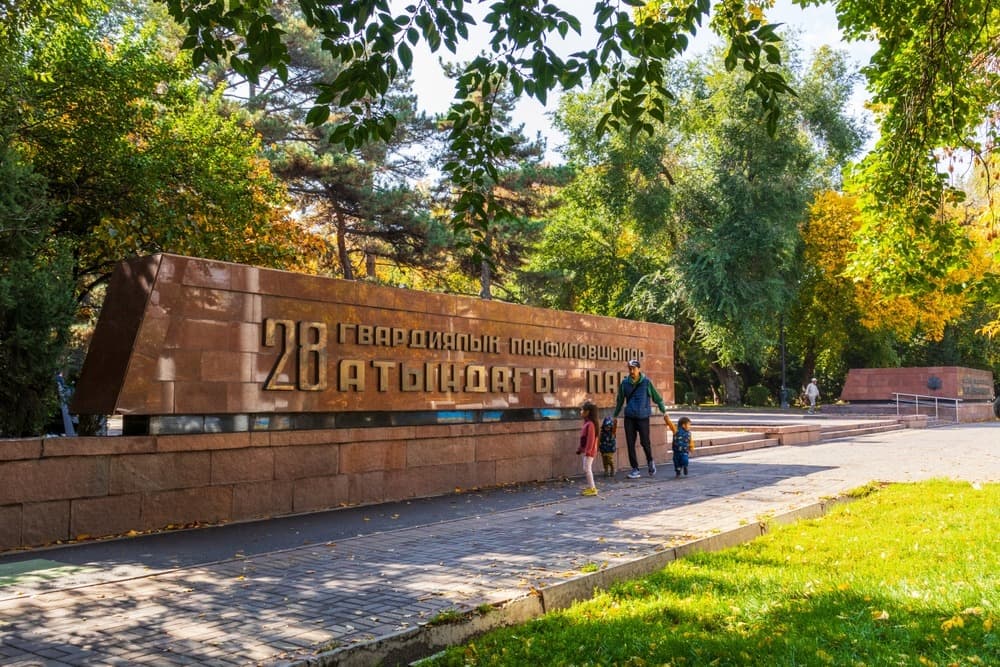
The current name was adopted in 1942, in tribute to 28 soldiers of the 316th Infantry Division commanded by General Ivan Panfilov. Originating mostly from Almaty and Bishkek, they participated in November 1941 in the defence of Moscow against a numerically superior enemy force. The episode became a founding narrative of Kazakh Soviet patriotism.
What to see in the park
The Ascension Cathedral
Built between 1904 and 1907 by engineer Andrei Pavlovich Zenkov, the Ascension Cathedral is entirely constructed of wood. According to local tradition, it was assembled without using metal nails. At 56 metres high, it ranks among the world's tallest wooden structures. The building withstood the 1911 earthquake that devastated much of Almaty. Used for various purposes in the twentieth century (museum, radio station), it was returned to the Russian Orthodox Church in 1995. Its gilded domes and polychrome facades make it the park's visual landmark.
The Kazakh Museum of Folk Musical Instruments
Located on the park's east side, the museum occupies a wooden building constructed in 1908 and converted into a museum in 1980. It houses over 1,000 traditional Kazakh instruments, classified into some sixty types, with certain pieces dating back to the seventeenth century. Outside the entrance stands a sculpture depicting the narkobyz, an emblematic bowed instrument. The Sazgen folk ensemble regularly performs live here.
The Glory Memorial and Eternal Flame
Inaugurated in 1975 for the 30th anniversary of the 1945 victory, the Glory Memorial unfolds in three sculptural compositions:
- The Oath, dedicated to young fighters for Soviet power;
- The Feat, celebrating the heroism of the 28 Panfilov Guardsmen;
- The Trumpets of Victory, symbols of life and triumph.
An eternal flame burns before the memorial, framed by cubes of labradorite containing earth brought from USSR hero cities. The ensemble has been classified as a historic, artistic and architectural monument since 1980.
The Heroes' Avenue and individual monuments
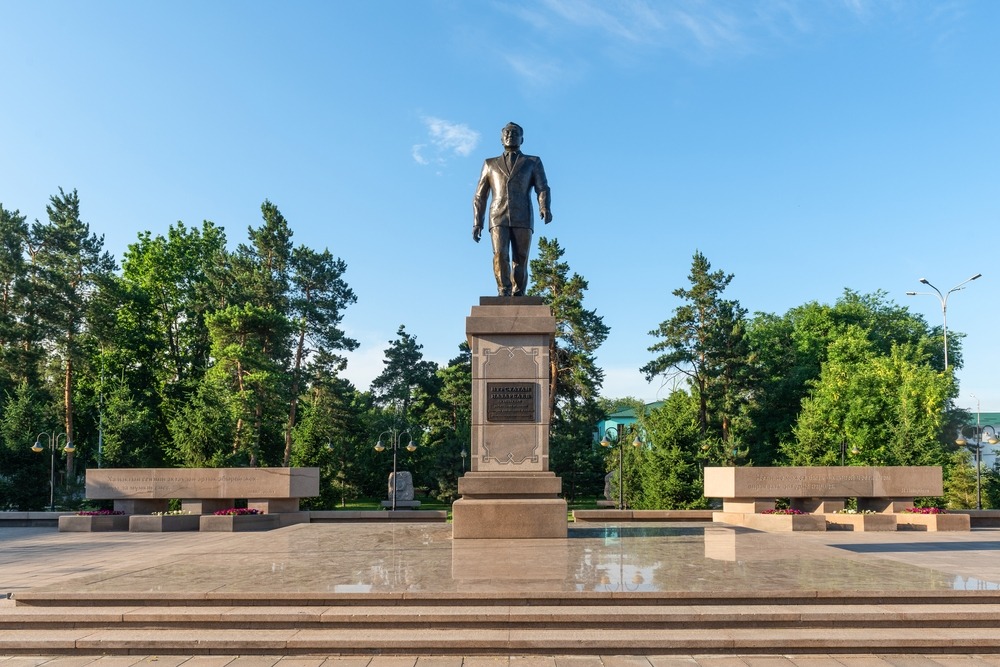
The Heroes' Avenue begins with the bust of Ivan Panfilov, erected in 1968 on a granite pedestal. Along the paths, several other monuments punctuate the walk:
- Bust of Tokash Bokin, Soviet revolutionary (1980);
- Monument to Afghan warriors (2003), three bronze soldiers honouring 69 Kazakhs who died in Afghanistan;
- Monument to Bauyrzhan Momyshuly (2010), writer and World War II hero.
Practical information
- Access: free entry, park open continuously.
- Duration of visit: allow 1 to 2 hours to tour the three main sites, longer if you visit the museum.
- Cathedral: appropriate dress required, photography generally tolerated without flash outside services; check on site before photographing the interior.
- Instruments museum: modest entrance fee, closes one day per week.
- On site: wide paths suitable for cycling and scooters, shaded benches, cafés and picnic areas on the periphery.
When to visit
The park can be visited year-round, but each season offers a different atmosphere. Spring (April–May) and early autumn (September–October) are the most pleasant periods, with moderate temperatures and green or golden foliage. Summer remains enjoyable thanks to the shade of centuries-old trees. In winter, snow highlights the cathedral's domes, but cold is pronounced.
The busiest date is 9 May, Victory Day: residents lay flowers and wreaths at the foot of the eternal flame and Glory Memorial. It is a powerful moment to understand Kazakh collective memory, but crowds are substantial.
How to get there
The park lies in the heart of Almaty, a short walk from Republic Square and the city centre's main hotels. From the city centre, allow less than an hour's walk via Tole Bi Street.
By metro, Zhibek Zholy station is about ten minutes' walk away. Numerous bus and trolleybus lines also serve the park's surroundings; routes change regularly, so verify operating lines via a local application (Yandex Maps, 2GIS).
By car or taxi (Yandex Go), the journey from the city centre takes about twenty minutes depending on traffic.
What to see nearby
The park lends itself well to a day discovering the historic centre. In the immediate vicinity, you can extend your visit with the Green Bazaar (Zelyony Bazaar) and the pedestrian Zhibek Zholy Street. To deepen your understanding of the country's history, the Central National Museum of the Republic of Kazakhstan perfectly complements the visit. If you have more time around Almaty, Charyn Canyon and Kaindy Lake rank among the region's most striking nature escapes.
FAQ
Frequently asked questions
No. Access to the park, the Ascension Cathedral and the Glory Memorial is free. Only the folk musical instruments museum charges a modest entrance fee.
Allow 1 to 2 hours to tour the three main sites and principal monuments. If you wish to explore the instruments museum in detail, add 45 minutes to 1 hour.
Photography is generally tolerated without flash outside of services, but remains at the discretion of the clergy. Avoid photographing people at prayer and adopt appropriate dress (shoulders covered, headscarf for women).
Yes. Wide paths, shaded areas, cafés and picnic zones make it a practical stop for families with children. Cycling and scooters are permitted here.
Preparing your trip
Panfilov's 28 Guardsmen Park is a natural stage in a stay in Almaty, often combined with the Tian Shan mountains, Charyn Canyon or high-altitude lakes. For a tailor-made itinerary including this visit, consult our Kazakhstan journeys.
Interested in this visit?
We can include it in your personalised itinerary.