Zharkent Mosque
Zharkent Mosque
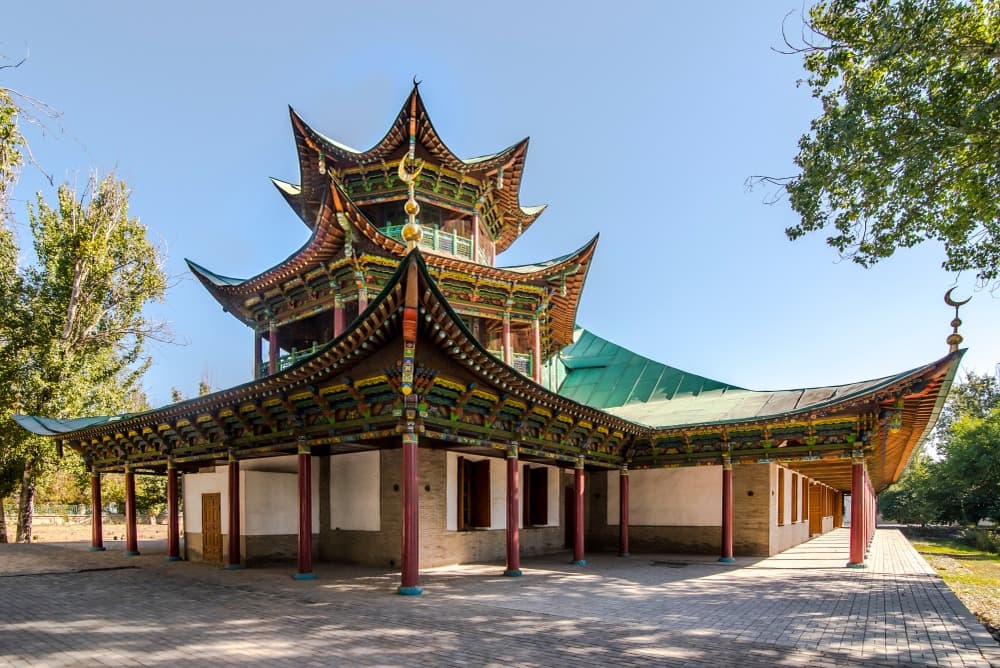
A unique wooden structure blending Chinese pagoda and Islamic tradition, the Zharkent Mosque bears witness to the Uyghur heritage of the Jetisu region.
The Zharkent Mosque is one of the most singular wooden structures in Central Asia. Built in the late 19th century by a Chinese architect and Uyghur craftsmen, it marries the codes of the pagoda with those of Central Asian Islamic tradition. Located in the small town of Zharkent, near the Chinese border, it functions today as a museum while maintaining a place of worship.
Why visit the Zharkent Mosque?
The site combines several rare features. The main building was assembled without nails or metal pieces, using traditional carpentry techniques of tenons, mortises and interlocking joints. The roof with upturned eaves and the minaret shaped like a pagoda bear the mark of Chinese influence, while the mihrab and main portal draw on Central Asian Islamic traditions.
The mosque survived an earthquake in 1910, a hurricane in 1965 and several decades of misuse during the Soviet era before being restored. It has been classified as a monument of republican architectural importance since 1982. For a traveler interested in craftsmanship, Uyghur history or the cultural crossroads of the Silk Road, a stop here is fully justified, despite the town's remoteness.
History
Before becoming an outpost of Tsarist Russia, Zharkent was nothing more than a small Uyghur village. In 1887, at a local Muslim assembly, first-guild merchant Vali Akhun Yuldashev (also spelled Valiakhun) proposed the construction of a grand mosque, financed its initial phase and organized a vast fundraising campaign, notably among Uyghurs from Kouldja (Ghulja, in present-day Xinjiang).
The project was entrusted to Chinese architect Hon Pike (also known as Hon Piquet, Hong Pik or Mukan), assisted by a team of master Uyghur craftsmen: Hassan Imanov, Ushurbaki, Tair Ismailov, Nasretdin Kara, Zainutdin and Abdukadir. More than a hundred craftsmen participated in the work. The main mosque was built between 1892 and 1895. A small annexe mosque, a madrasa and the enclosure were added between 1903 and 1905.
The 1910 earthquake caused severe damage: collapse of decorative towers, cracks in domes, closure of the main entrance. The 1965 hurricane added to the deterioration. During the Soviet period, the building was successively used as a warehouse, shop, grain store, border guard barracks, cinema, tea house and even a stable. The first protection studies were conducted in 1948–1949.
A major restoration took place between 1975 and 1978. By decree of March 24, 1978 from the Council of Ministers of the Kazakh SSR, signed by Baiken Ashimov, the mosque was transformed into a museum of architecture and art. The personal intervention of Dinmukhamed Kunayev, first secretary of the Kazakh Communist Party, played a decisive role in its preservation. A new phase of work between 2001 and 2004 addressed the roof, the portal and general consolidation.
What to see on-site
The portal and minaret
Entry is through a monumental arched portal of Central Asian inspiration, adorned with Arabic inscriptions and floral motifs. The minaret rises to 19 meters and takes the form of a two-level pagoda, surrounded by 52 carved columns and crowned with a golden crescent. This area gives the clearest reading of the structure's stylistic fusion.
The prayer hall
The building measures 28 by 54 meters and stands 14.5 meters high. The main hall, with a capacity of around 1,000 worshippers, rests on 122 wooden pillars. The wood used is spruce from the Tian Shan mountains, harvested in the Aksu and Ketmen ranges. The décor combines wood carvings, polychrome paintings, plant motifs, Arabic inscriptions, Uyghur ornaments and representations of birds, fish and real or mythical creatures. Men prayed on the ground floor, women in the upper gallery.
The madrasa and museum spaces
The madrasa, located south of the complex, once housed religious instruction in separate areas for boys and girls. The former classrooms now display traditional Kazakh and Uyghur objects and trace regional life before the Russian arrival.
The courtyard and enclosure
The entire complex is enclosed by a stone wall 2.3 meters high, with entrances on the north and south sides. Wooden lattice panels, ceramic elements and floral décor complete the site's harmony.
Practical information
The mosque functions both as a museum and as a place of worship. It is open most days during daytime hours, with a weekly closure (usually Monday) and reduced hours on Sunday. The entrance fee remains modest, with a supplement for interior photography. Guided tours, offered in Russian and Kazakh, are the norm; for commentary in French or English-speaking guides, you must arrange a private guide in advance from Almaty.
The site requires respectful dress: head and shoulders covered for women, no shorts for men, shoes removed before entering the prayer hall. Certain areas may be inaccessible during prayers. Allow 1 to 1.5 hours on-site for a complete visit, including the madrasa.
When to visit
The Jetisu region, where Zharkent is located, is comfortably visited from late April to early October. May–June and September offer the most pleasant temperatures and generally clear skies. Summer is hot and dry, with days that can exceed 30 °C in the Ili valley. Winter, from November to March, brings dry cold and sometimes difficult roads toward the Chinese border: the visit remains possible but access from Almaty becomes complicated in case of snowfall.
How to get there
Zharkent is located approximately 300 km east of Almaty, near the Khorgos border crossing with China. The A-353 road connects the two cities in 4 to 5 hours of driving, crossing the Ili valley. Minibuses (marshrutkas) depart daily from Sayakhat bus station in Almaty. Most travelers incorporate Zharkent into a broader circuit in the Jetisu region, combining it with other sites accessible from the same road.
Nearby attractions
Along the Almaty–Zharkent route, several sites complement a multi-day loop:
- The Charyn Canyon, halfway, famous for its Valley of Castles.
- The Kapchagay Reservoir, the first stop leaving Almaty.
- The Alakol Lake, further northeast, to extend the itinerary into the Jetisu region.
- In Almaty itself, the National Central Museum provides useful historical context before or after the visit.
Frequently asked questions
Frequently asked questions
Yes. Although it was transformed into a museum of architecture and art in 1978, it retains a place of worship function. Regular prayers are held there and certain areas may be closed to visitors during these times.
Interior photography is permitted for a supplement to the entrance fee. During prayers, however, it is forbidden. For the carved décor and painted ceiling, plan on a camera with good low-light sensitivity.
It's possible but lengthy: 4 to 5 hours of driving each way. Most travelers prefer to spend a night there, or incorporate the visit into a circuit combining Charyn Canyon and the Ili valley over two to three days.
Head and shoulders covered for women, long trousers or below-knee skirts. For men, no shorts. Shoes are removed before entering the prayer hall: plan on clean socks.
Planning your trip
The Zharkent Mosque fits into an eastern Kazakhstan itinerary where each stage requires driving. To build a coherent stay combining Almaty, Jetisu and the Chinese border, consult our Kazakhstan travel guide and our custom itinerary suggestions.
Interested in this visit?
We can include it in your personalised itinerary.