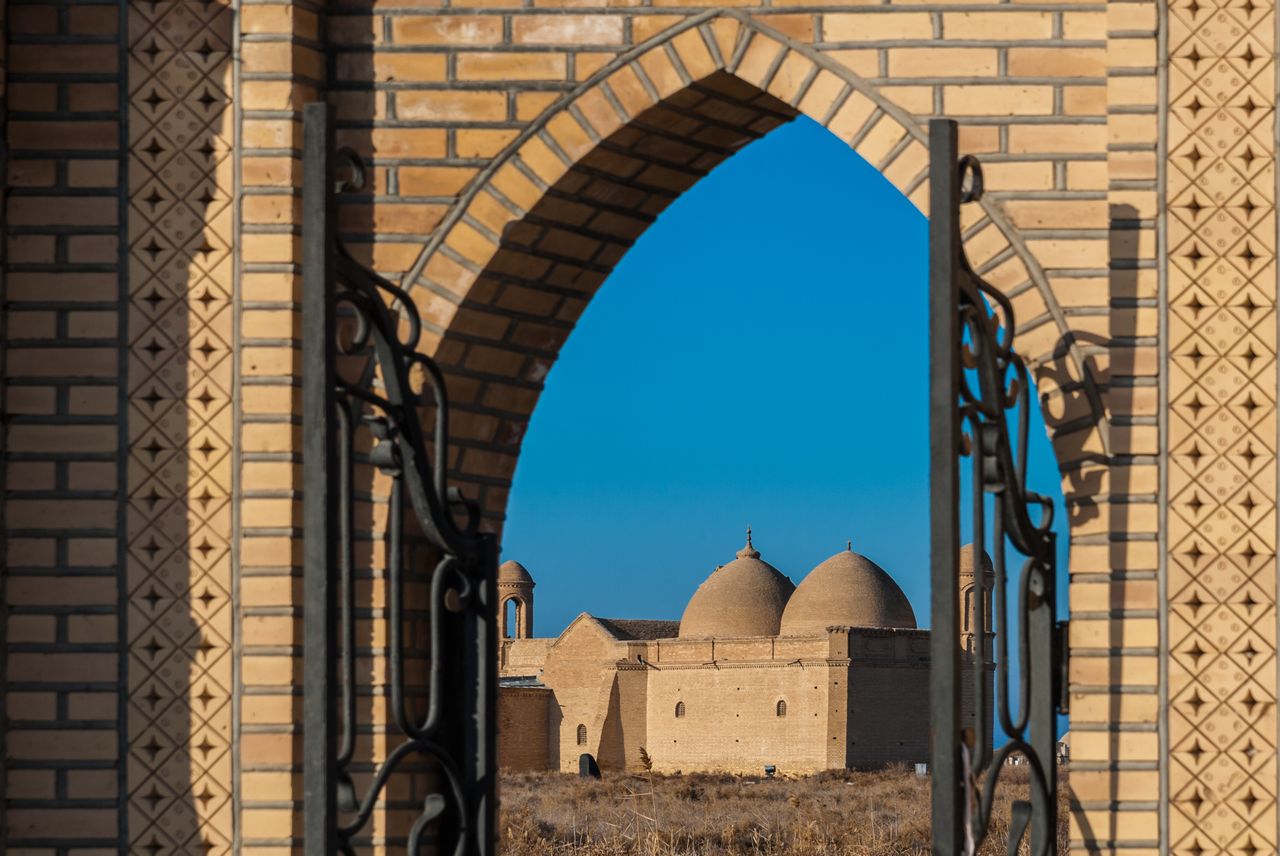
Ruins of Otrar (Otyrar)
Otrar, a medieval Silk Road city in southern Kazakhstan, was the birthplace of Al-Farabi and the catalyst for the Mongol invasion in 1218. Its vast archaeological site, designated a UNESCO World Heritage property, reveals centuries of history across the steppe.
Otrar is a vanished medieval city, today reduced to an expansive tell of earth and unfired brick scattered across the steppe of southern Kazakhstan. A crossroads of the Silk Road between the 9th and 15th centuries, it was the birthplace of Al-Farabi and the scene of the 1218 massacre that triggered the Mongol invasion. Its archaeological site, inscribed on UNESCO's World Heritage List, ranks among Central Asia's most significant.
Practical Information at a Glance
- Access: the site lies approximately 150 km northwest of Turkestan, near the village of Shauildir; a car or taxi from Turkestan is necessary.
- Suggested duration: 1.5 to 2 hours to explore the main tell and site museum.
- Attire: hiking shoes recommended; the terrain is uneven.
- Restrictions: do not climb fragile archaeological structures.
What to See
The site presents itself as an immense artificial mound — the tepe — formed by the accumulation of occupation layers spanning more than a millennium. Kazakh-Soviet and later Kazakhstani excavations have uncovered residential quarters, public baths (hammam), a citadel, and pottery workshops. A modest site museum displays ceramics, coins, and everyday objects recovered during excavations.
History and Context
Founded around the 1st century CE, Otrar reached its peak under Turco-Islamic dynasties between the 9th and 13th centuries. In 1218, the city's governor massacred a merchant caravan sent by Genghis Khan — an act that provoked the devastating Mongol campaign across Central Asia. The city recovered partially under Timur, who died there in 1405 during an expedition toward China. It was finally abandoned in the 18th century following destruction by the Dzungars.
Al-Farabi (872–950), a leading philosopher and musicologist in the medieval Islamic world, was born here. His intellectual legacy remains a source of national pride for Kazakhstan.
Highlights of the Visit
The Central Tell
From the summit of the main mound, views across the Syr Darya plain and the vestiges of the ancient urban layout convey the scale of this once-great city. Visible strata in the exposed sections testify to centuries of reconstruction.
The Site Museum
Modest yet well-documented, it contextualizes the archaeological discoveries: glazed ceramics, metal tools, seals, and coins illustrate the daily life of a prosperous trading city.
The Hammam Remains
The partially excavated public baths reveal a hypocaust heating system, evidence of the urban comfort achieved before Mongol destruction.
Photography Tips
Raking light in early morning or late afternoon accentuates the tell's relief and shadows of excavated structures. Avoid midday in summer: the steppe offers little shade and light becomes harsh. A wide-angle lens captures the full extent of the site within its arid plainland context.
Location and Access
Otrar lies in the Turkestan region, near the confluence of the Arys and Syr Darya rivers. The city of Turkestan, with its Mausoleum of Khoja Ahmed Yasawi, serves as the natural logistics base. From Turkestan, allow approximately two hours of driving. No regular public transport reaches the site; a taxi or rental vehicle is essential. The site is accessible by ordinary car in dry conditions; after rain, the tracks can become difficult.
In the Vicinity
- Mausoleum of Khoja Ahmed Yasawi — a masterpiece of Timurid architecture in Turkestan, UNESCO-listed.
- Kerderi Necropolis — a medieval funerary complex in the same region, less visited.
- Ruins of Sauran — another medieval steppe city in Kazakhstan, a few hours' drive away.
Interested in this visit?
We can include it in your personalised itinerary.